The Good Deed

tn-suitcase_duct_tape-550x450-rd10

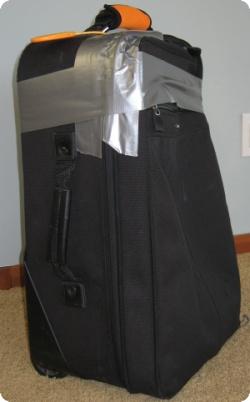
“Please”, she implored, her hands outstretched, “I’m desperate, Ma’am”. Her dirty fingers, their unkempt nails black and torn, protruded through tattered fingerless gloves. Her clothes, layered to combat the cold winter weather, hung on her frame as though her shoulders were a hanger. She dragged along a torn black patched rolling suitcase with a broken wheel. Gray duct tape was wrapped around it to keep it closed. A handful of bulging plastic bags was anchored to its handle.

But mostly it was her face I remember: From her high forehead dangled limp colorless strands of greasy hair. Her porous skin was pitted and chalky, a forest of dark coarse hairs growing above her chapped upper lip and on her chin. Her teeth were dark grey, there was a yellowish smear on her cheek and the fading remnants of a shiner under one of the small, dark eyes that locked onto mine as Arturo and I piloted our shopping cart through Target’s parking lot to my car.

“Please,” she repeated. Her voice, nasal and soft, had a faintly southern twang. “I know you all are leaving but I need some help. I’m not askin’ for a handout”, she said, moving closer. “I’m desperate, I just need a ride. Or fare for a ride. Bus fare, could you all give me some bus fare so I can go get my husband from the hospital? Like, maybe five dollars?”.

“Bus fare?” I repeated.

“Yes Ma’am. See, my husband just got out of the hospital, he’s sick with the heart failure and he was admitted to Kaiser ‘cause he can’t breathe sometimes when it gets cold.  . . . it bein’ winter and all . . . . and he just got out today and he’s waitin for me there, and I’m trying to get a ride or bus fare, Ma’am, that’s all, for him and for me. I’d walk it but he’s waitin’ outside and it’s a coupla a miles . . .I’m trying to get myself down there, it bein’ cold and all . . . .” Her explanation trailed off.

“Actually”, I replied, as Arturo and I lifted our bags out of the cart, “I’m headed almost to that exact location”. I carried the bags to the rear of the car and opened the hatchback.  “Yah, sure,  I’ll give you a ride. Arturo, ride in the back just for a bit.”

The two of them just stood there, not moving.

I placed the bags in the back of the car. “OK, lets bounce. It’s cold”, I said.

I closed the hatchback, then opened the passenger-side back door, then the passenger front door, and then walked around the front of the car to the driver door and opened it.  “Let’s get in”, I said. I could see my breath when I spoke. “I’ll turn on the heater”.

“Get in there?”, the woman repeated, gesturing toward the car with her chin and keeping her eyes on me.

“Yah, Arturo won’t mind the back seat for 10 minutes, will you Arturo?”

I looked at them over the roof of my car, where they stood next to the open doors. They stared back, wearing identical expressions of frozen incredulity.

“Arturo, what’s wrong with you?” I said. “It’s cold, come on”.

“Uhhhh, okay”, Arturo replied.  “Here”, he said to the woman, “get in”, he instructed, his hand on the open passenger door. The woman looked briefly around her and then slowly entered the car and sat on the edge of the passenger seat. Arturo slammed her door, then slid onto the back seat. As I started the ignition, I said, “we can give you a ride right to Kaiser, I’ve got an appointment practically next door to it in half an hour.”  Pulling out of the parking lot, I added,  “I just have to stop quickly for gas, or we’ll be pushing the car!”

Waiting for the traffic light to change, I observed, “pretty cold out, huh?”

“Yes Ma’am”, the woman whispered, tightening her arms around the black suitcase she held on her lap. She turned so that her back was pressed against the passenger door.  As I drove the next few blocks, she stared at me without moving. By the time we hit the next red light, the back of her head was pressed up against the passenger side window and her right elbow was touching the glove box door.

The seatbelt alarm began beeping. “Could you fasten your seatbelt, please?” I asked her as I accelerated through the next traffic light.

The woman continued to stare at me without speaking.

“Bleep bleep”, went the seatbelt alarm.

“The seatbelt’s tucked down near the floor on your right”, I informed her.

She wrapped her arms tighter around the black suitcase.

“Bleep, bleep.”

I spied a gas station and steered into the right lane.

“Um, I think I’ll get out here, Ma’am . . . I can get out anywhere, Ma’am . . . I can get out right here”.

“I just have to stop for some gas,” I replied, slowing down. “It’ll just take a minute, I’m totally on reserve”. With this, I pulled into the gas station and cruised slowly to a stop at the pump.

While the car was still moving, the woman opened the door and leapt out of the passenger seat. Clutching the suitcase to her chest with both arms, she took a few steps backward and looked around, as though seeking assistance. “Whoa, whoa, what is it?” I said, getting out of the car. “We’re not there yet.”

“Uh-hunh”, she replied levelly, taking another step back.

It was when Arturo got out of the car that the woman plunked her suitcase onto the ground. The broken wheel made it cant comically to the side. She pulled out its telescoping hand grip and stepped back again. Pinning her eyes on me, she slowly said, “I’m not goin’ anywhere with you all.” Moving deliberately, she slowly walked backwards, dragging the suitcase, looking back and forth between me and Arturo. When she was about 20 feet away, she suddenly turned away from us and broke into a clumsy jog, the suitcase bouncing along the pavement behind her. She jogged down the gas station driveway, and then, after casting an apprehensive look over her shoulder in our direction, she scurried across the street and down the sidewalk, the suitcase bumping along behind her, until she was out of sight.

“What the hell!?” I said, staring after her. “We’re still pretty far from Kaiser”.

Arturo was standing next to the gas pump laughing so hard, he was doubled over. “Oh my God”, he gasped, wiping his eyes. “Don’t you get it?”

“Get what?”, I asked.

“She thought she was in danger. From us. I’m sure no one ever let her into their car before and then you come along and instead of giving her change –  like everyone else – you frickin’ invite her into your car to give her a ride…..Oh my God, she was freaked out . . . she thought we were abducting her . . . Not only does she not score any money, but she’s figuring she’s either going to be , like, abducted, tortured and killed in the car or end up just—just—marooned at frickin’ Kaiser . . . oh my God!” He burst into peals of laughter again, laughing so hard he was groaning. “Oh my God”, he exclaimed. “You really gave that woman a ride in your car! Kaiser! Oh my God.” He paused to wipe his eyes.

“Anything else, while you’re still enjoying a good laugh at my expense?”, I asked, removing the nozzle from the pump.

“Um, yes”, Arturo answered. “We’d better get out of here before she calls the police”.

 MATH BLOCK: A Math Story That’ll Make You Laugh Out Loud

202856-math-anxiety
“Your daughter has a serious math block”, Mrs Lederer advised my parents at the mandatory conference at the end of my fifth grade year. “She needs a tutor”.

Although I knew, of course, that math wasn’t my strong suit, I wasn’t aware that I actually suffered what sounded like a quasi-medical problem, so Mrs. Lederer’s pronouncement filled me with excitement. A “math block” sounded like a significant, rare, possibly even exotic condition, almost a diagnosis, one that wasn’t too personal to drop casually into conversation for minor dramatic effect, like my friend Ruthie referenced her allergies. I had deep admiration for Ruthie’s deft use of allergies to decline all the food she hated. Aside from giving her an unchallenged pass on kiwis and mushrooms, it placed her in an elite group of classmates with special conditions, of which I had exactly none: no allergies, never a cast, glasses, or braces; not even divorced parents, much more a rarity in the early 70s than now.

Since having a math block was like having math allergy, I expected it would afford me similar protection, as long as I remembered my manners. “No thank you”, I’d say next year when our sixth grade math teacher passed out the pop quizzes we all dreaded. “I have a math block,” I’d explain, “so I can’t do fractions or take math tests”. Here I’d pause, before politely adding, like Ruthie did, “you can ask my parents”.

Despite my parents’ obedient acquisition of a long succession of math tutors, as years progressed it became clear that Archimedes himself could not illuminate the darkness that shrouded the path to my understanding mathematics. The simple truth, reduced to its essence, was if I couldn’t memorize it, like the times tables, I couldn’t do it. Algebra, in particular, would prove to be my undoing.  “It’s amazing”, exclaimed Tutor #2, scrutinizing my abysmal practice sheets with growing wonder. “You actually do better when you randomly guess the answer than when you try to work it out”.

This was true. Even with help from the tutors, I failed Algebra twice, took it two more times, and then managed to pass it only after my teacher tutored me one summer, cleverly using the opportunity to feed me every question and every answer that would be on the final test.

Algebra was so traumatic for me that merely seeing a negative number on a piece of paper flooded my body with adrenalin, jump-starting me into high anxiety mode. Already disgruntled by any number system that incorporated the alphabet, I simply could not understand Algebra’s application; lacking that information, I would never conquer it.

“But what is it for?” I would demand of the tutors.

“Math is a language”, they’d intone. But it wasn’t; I was good at languages, and I knew what they were for. You needed language to say “Take your bare ass off my pillow”. Try saying that with integers.

“What is algebra for?” I’d ask the next tutor.

“You’ll find yourself using Algebra over and over again in many different ways throughout the rest of your life.” In the five decades that have since passed, years that have encompassed activities as disparate as practicing law and gardening, grieving and getting high, traveling and voting, hiring people and burying them, shooting pool and raising children, studying Sanskrit and skiing — I cannot recall a single instance that called for the factoring of polynomials.

“What is the purpose of Algebra?”,  I paraphrased.

“Algebra”, Tutor #4 declared grandiosely, “is about logic”.

“Logic”, I repeated, stupefied. “Logic?”

Indeed, of all possible answers, “logic” was the least credible. Algebra was anything but logical. It seemed, actually, to defy logic, featuring among other mysteries the categories of  “irrational numbers”, which seemed to me not only to be stating the obvious, but also rubbing it in.

While negative and irrational numbers confounded and frustrated me,  I was driven to foot-stomping tantrums by the introduction of imaginary numbers.  Evidently, these are numbers that don’t even exist — or, if they do, it’s only in your imagination, like playmates and monsters. Their existential nature frustrated me to the point of hysteria, which the tutors could not quell. “How am I supposed to learn something that isn’t real!” I shouted, sweeping my workbook off the dining room table.

What kind of person, I wondered, would devise a system requiring us to make calculations with numbers that didn’t exist?

I’ll tell you what kind. Imagine a bunch of mathematicians in the year 525 – Greek, so they’re in togas, sitting on white marble blocks in a hotel ballroom, fiddling with their protractors or whatever. One quietly tunes his lyre as the group discourses on the wonders of the number systems they’d been inventing:

Thales: You know, guys, we’ve done a hell of a job with the math–we’re rockin it!

Pythagoras: Yep…..right on schedule for A.D. . . . I can’t wait! I really think the number systems we’ve invented could change the world! (Strums a chord)

Polycrates: Listen, Thag, excuse me;  guys, something’s been bugging me, ya know, I hate to be a big downer . . . but am I the only one thinking we should somehow  . . .  back up our work? What if our numbers get lost or  . . . stolen  . . . you know the Egyptians, they do have that reputation . . . not that I’m ethnic stereotyping . . . but . . . suppose we “misplace” our numbers? It’s happened before, remember? That time we invented last names for everyone, and then lost them all?

Pythagoras: Excellent point, Crate. (And by the way, the last name thing never really caught on, to tell you the truth.)  Thales and I share your concern about our number systems being lost or . . . “borrowed”. (Strum) And we studied the problem from every angle, and as we did, we reached a momentous conclusion. (Buzz of excitement from the men.) Tell them, Thales.  (Strum)

Thales: Well, what we found was that the world seems to consist of opposites . . . yet  . . . it seems a thing can become its own opposite! Therefore, they cannot truly be opposites but rather must both be manifestations of some underlying unity that is neither! (Gasps and murmurs of disbelief.)

Anaximander: Sooo . . . .?

Pythagoras: So, our number systems are an essential part of this theory. . . . Men, Thales and I have reason to believe these number systems are far more important than any of us ever dreamed, and we just can’t risk losing them. They need to be up and rolling by A.D.. So I invented a set of, well – standby numbers . . . as backups, in case we lose the ones we’ve established so far. These backup numbers exist only in our minds, only in memory, you see . . . so I call them . . .  (fast thrilling riff of flamenco chords) . . . imaginary numbers!

Pherykides: : Well done, Pythagoras. (Searching toga for pen.) Hey Crate, do you have a

 quill I can borrow?

******

Along with Algebra, word problems presented a special challenge. Word problems were an ugly trick math teachers devised to lull their verbal, math-blocked students like me into the false confidence we could solve math problems. Bait and switch!

“Word problems”, I thought triumphantly. Words! Now here finally – sixth grade – was arithmetic at which I could excel, for if anyone could solve a word problem, it was I. I was great with words, I loved words and welcomed them and their problems into my life. Crossword puzzles, Scrabble, newspaper jumble – pitch ’em my way, I thought smugly. Good or well? I or me? Further or farther? Hanged or hung, lit or lighted, lay or lie? Oh yes, I relished a good word problem. If they wanted to throw in a couple of numbers so they’d qualify as “arithmetic”, I was sure I could handle it.
It took just one test to puncture my confidence. These weren’t “word problems” at all. They were just math equations lurking like spies in an unsuspecting community of words: Algebra, undercover.

And, typical of school textbooks in the 1970’s, the action in the word problems was tedious and hopelessly pedantic, consisting of the mind-numbing activities of “Jack”, a boy of undisclosed age, who spent his time sorting fruit into baskets, or riding the train roundtrip between the same two cities. Back and forth and back and forth Jack traveled, his purpose unexplained. With no apparent job or hobby, no requirement he attend school, no parents or authority figures telling him what to do, and evidently, no obligations at all, Jack was a figure of both envy and derision.

Given Jack’s leisurely lifestyle, it was patently unfair to burden us – busy with class, homework, scouts, ballet, and karate – with the task of calculating how fast his train was moving based on what time it arrived at the station, especially when he never even got off. Jack could jolly well figure it out himself. After all, he had nothing but time, and his interest in the answer couldn’t possibly be any any slighter than our own.

Today, I view Jack’s plight with far more insight, and no small amount of pity. If back then we’d only just given him a friendly wave and maybe said, “ Hey, Jack”,  that might have given him some relief from his hopeless, helpless fate, with its unavoidable implications of  sexual impotence and forlorn human isolation. Marooned on the train, trapped forever in a looping circuit he could not control, Jack’s destiny was to travel continuously but never to arrive. Whatever relief he scrounged from occasionally tossing oranges into this basket and apples into that one would have been minimal indeed compared to the bleak reality of his endless round trip journey to nowhere.

I rarely saw Jack again after I left sixth grade; for all I know, he is still on the train.. Word problems weren’t particularly well-suited for Geometry anyway. And ultimately, it was Geometry that saved me. It was a logical, useful discipline whose application was obvious: you could use it to build houses or draw basketball courts, make newspaper hats and paper airplanes, play air hockey and design bridges. The angles weren’t negative, the theorems weren’t irrational, the proofs weren’t imaginary. Since this made sense to me,  my math block improved a bit, and I started getting “9”‘s on math tests instead of “3’s.

Our pal Pythagoras – who frankly had no business fooling with all those numbers that didn’t exist, when there was an infinite amount of perfectly real numbers available and seeking employment  – became obsessed with a triangle he met at the 520 B.C. Summer Olympics and ended up writing this theorem about her that became really popular and eventually went platinum. I learned it and still recite it in the car or shower sometimes. It’s the only math theorem I know. Ha, Mrs. Lederer! I knew could do it. Take that!

-by Caro Marks

Copyright 2015


Three-Minute Mike

THREE-MINUTE MIKE Three-Minute Mike was the very first man – and the last – I met on an Internet dating website. Our final date occurred about a month after we met, after some rather transparent probing (his), aimed at ascertaining whether I was going to have sex with him readily, or would make him labor for it (he evidently never considered the third option). We had shared two brief hugs by the time of this date, our third, dinner at a local Chinese restaurant.

His opening conversational strategy was to shock, as after we ordered dinner, he coyly informed me (“Heh – want to hear a secret?”) that his penis and both nipples were pierced. Reportedly (I never saw it), the penis sported a curved silver barbell, inserted through the underside of the head of the organ and perpendicular to it. After a few sophomoric questions (“did it hurt?”), I settled into a meditative silence, musing on his rueful disclosure that a former girlfriend had in fact chipped a tooth on the “large, heavy jewelry” with which he used to adorn his penis. These days, he added, he rarely sported the “big bling” anymore, as it made sex uncomfortable for him (never mind his partners!). He confided that this particular piercing was designed for sexual pleasure; specifically, to stimulate a woman’s “G-spot”. And, he boasted, he had special condoms that accommodated the various swag he could attach to the small barbell. As he finished his glass m of water and started in on mine, he assured me the barbell would “tickle” my G-spot in ways I had heretofore only dreamed of.

The patronizing tone in which he delivered this promise was so irritating, his presumptions so appalling, and his decision to express them to me indicative of such poor judgment, that I momentarily considered just walking out. But he fascinated me in a repellant way, sort of like a giant centipede: I daren’t go too close to him, but it was all too interesting to look away. I wondered if his genital jewelry – whether small and dainty, or the big gems he said he preferred – would not be an irritant to the female organ, rather than a pleasurable enhancement.

Too, I pondered how any woman could view a bejeweled penis without–well, laughing. I could not erase the vision of one of Great-aunt Louella’s beloved Cartier sapphire earrings, so weighty that both of her earlobes were permanently elongated, attached showily to the tip of the male sex organ, dangling like a wind chime or turning slowly like a Calder mobile. The intrinsic impossibility of the image caused me to shudder: Elegant, elderly, cantankerous Aunt Louella’s favorite earring hanging from a-a–a what? A penis?

Three-Minute Mike had no sense of social decorum, no feel for the conventions and unspoken rules that regulate all human interactions. If it is true that our relationships with one another are governed by implied social contracts, Three-Minute Mike managed heedlessly to breach every clause of ours as our month “together” progressed, musing out loud about my salary, plucking food off my plate without asking, observing I colored the gray in my hair, showing up half an hour early for a date, and blurting out unwelcome intimacies. Put plainly, the man had no filter.

Accordingly, it was at this dinner, over General Tso’s Chicken, that he chose to share yet another unsolicited confidence, one that quite took away my appetite (for him or for dinner): that his “equipment” was jumbo-sized — an absolute colossus of a penis perfectly in scale with his 6’4″, 280-pound frame. And, he added as he spooned chicken onto our plates, he was “damned good in bed”. He “knew how to use” his “equipment”. “Let’s just say”, he smirked, “I don’t get any complaints from the ladies, if you know what I mean. Heh.”

I did know what he meant, of course, but I couldn’t dwell on it even for a second, as I strained to process the astonishing fact that the topic of our dinner conversation, if I did not change it, was going to be an adult human penis I had never seen and was never going to see; a penis to which I felt less attraction than I did to General Tso himself, now a century dead; a penis which, in fact, I wouldn’t help across the street in a blizzard even if it slipped in the crosswalk and fell down right in front of me.

As my brain raced to find a safer topic for discussion, Three-Minute Mike, twisting the cap off the bottle of soy sauce and dumping most of it of it into the bowl of rice we were supposed to share, brayed, “Oh no, no…heh…I am not one of those three–minute guys, wham bam, you know… not by a long shot! Heh,” he chuckled, stirring the bowl of rice with his soup spoon, “I’m no three minute man….they don’t call me ‘three-minute Mike’! More like …. ‘three-hour Mike’! Heh.”

But worse – much worse – was yet to come. As he ate,Three-Minute Mike advised me that “women sometimes get infections after having sex” with him, especially women who have not had sex in a while. The latex of the condom, he lectured, using a chopstick as a pointer, along with the friction (and by the way he described it, one imagined actual sparks flying), generated by the jackhammering of his Bunyanesque member against the walls of my own female organ, (possibly for three hours!, I recalled in alarm), would “completely change the Ph balance in the vagina”. This, he admonished, somewhat anti-climactically, could lead to infections.

The Ph balance! As though my reproductive organ were a swimming pool and he the cabana boy charged with the weekly task of keeping it clean!

“Lemme warn you right now,” he confided with a little chuckle, “if we do take this to – you know – the next level – heh – be prepared for a yeast infection…..or even a urinary tract infection. Ouch, I know – right?” He drained his water glass and took a sip out of mine. “But it’s happened to more than one of my partners after the first time meeting, um, ‘Little Big Mike’ , heh, you with me? So maybe you might wanna think about starting antibiotics sooner rather than later, like, as a preventive measure?” Placing his used chopsticks on the tablecloth and unsuccessfully suppressing a burp, he scooped a large spoonful of rice out of the pool of soy sauce he’d drowned it in, and slurped it off the spoon into his mouth, his cheeks bulging as his tongue fondled the grains. Mesmerized by the dribble of soy sauce running down his chin, I waited, but he failed to wipe it away, and it disappeared into his beard.

This fact sealed the deal for me. As though the scenarios he conjured weren’t ghastly enough – his brute of a penis bombarding my alkaline-poor, chemically-unbalanced genitalia so furiously the condom shredded into a thousand pieces, black smoke stinking of burning electricity emitting from me as his member seared a trench through my poor little reproductive vault, spawning en route unpleasant, painful infections, plagues so inconvenient to our anticipated coupling that he was ready to take me to the pharmacy as soon as we paid our bill – my secret knowledge that a quarter teaspoon of soy sauce now stained the roots of the man’s beard – left me queasily unbalanced.

Explaining truthfully that I felt unwell and was certainly feverish (back of my hand pressed to my forehead for effect), I determined to flee. So anxious was I to leave that in my haste, I tangled my arms in my sweater as I struggled to put it on without taking it off the back of my chair. Even as my choppy efforts to dislodge my hands from the twisted sleeves caused my chair to tip precariously sideways, I managed to toss Three-Minute Mike a twenty dollar bill. He whipped it off the table with a fast, practiced flourish, one I’d seen on our two earlier coffee dates, when I’d offered and he’d accepted my $2.00 “share” of the check

When I declined to see him again, he objected. In a single 5-minute phone call he professed shock, then complained, then feigned indifference; then he wheedled, then he shouted; finally, he begged. He ran out of tricks when I refused to discuss my decision. I felt I owed him no explanation. In the month I knew the man, he did not give me a single reason to believe he was capable of learning from his mistakes.

The Language of Rain

It rained when we buried you. Your little boys
Ran and played as we carried you over the slippery grass.
You lay silently, curled in your small bed, unconcerned with
Our stumbling transport.
A weak sun made an uncertain appearance.
The rain diminished then returned. I understood its confusion,
For I too was diminished, condensed into the interiors of
My own smallness by the weight of your death.

Where are you now? This is the answer I still seek
In the gusting winds and chemical sunsets, and as I awaken
Into daybreak. When the clouds gather and threaten rain
I speak it into the darkening afternoon: Tell me, tell me.
Were is he?, I begged the graceful autumn. Where? I spoke it to the
Full moon and the drifting river. I wished the answer
From a field of thistles and a freezing creek.Where?
I believe I could find you
If only I understood the language of rain.

August 9. 2014

Cereal Memoirs: Breakfasts of Childhood

I love cereal. Along with hook & loop fasteners and Post-It Notes, cereal is one of humankind’s greatest achievements. Unlike some of the other delicacies popular during the 1970’s (Kraft Macaroni & Cheese), I have carried my fondness for cereal into my adult years. Indeed, there have been times in my adult life when a bowl of Cheerios was absolutely the only viable option for dinner.

For ten years of our lives, my two brothers and I spent an average (conservatively) of 650 hours – or 27 days –  sitting together at our kitchen table, eating cereal (five days a week x 15 minutes a day = 1.25 hours a week x 520 weeks). Qualitatively different from lunch, which we didn’t often eat together, and dinner, whose ambiance was affected by the presence of the parents, our cereal breakfasts, no matter how superficial the interactions, forged bonds between my brothers and me that endure to this day.

Raised in a drafty old house the Richmond district of San Francisco, we were three kids under nine years old, all departing for school around the same time each day. The second we awakened, we would quickly dress, then race down the cold hall. We’d make a crashing stop at the bathroom, and then tumble together down the curving stairway, yelling, shoving, kicking, and blocking one another in our haste to be first into the kitchen, the warmest room in the house. There, the old stove squatted next to a corner heating vent, and whoever got to it first could wedge himself in front of the vent, next to the stove, and get warm . . . . well, warm-ish.

 Warm-ish because the parents kept the thermostat so low that the vent emitted only the mildest whisper of heat, really more the memory of heat than the real thing, but it was better than nothing, and the first to reach it got to stay as long as he wanted, and could even get dressed right there. Our middle brother, M, usually won the race and he spent many mornings before school lodged in front of that vent, trying to absorb the faint wafts of heat while he daydreamed and ate his cereal.
Defeated, D and I would slink into the kitchen after him, and I’d climb on the yellow stool and take down one of my two favorite cereals. I don’t like sweets in the morning, so Rice Krispies were my mainstay. Next to the box, I’d put the carton of milk, and a bowl and a spoon, the three accoutrements that together comprise the international symbol for “I’m having cereal”. After preparing the cereal but before tasting it, I’d bow my head to the bowl to listen to the Krispies sing the short hym that made them famous, its snap-crackle-pop chorus always thrilling, even though it was – possibly because it was – so predictable.

On the other side of the table, my brothers did not share my aversion to morning sweets. M was a passionate aficionado of Cap’n Crunch. His ability to eat massive quantities of these abrasive, gritty, sugar-coated corn cubes without shredding the roof of his mouth to ribbons inspired genuine awe. I rarely took the risk, but when I did sample Cap’n Crunch, I nibbled it ever so cautiously, fretting the sharp nuggets would lacerate the roof of my mouth. I could not understand how anyone ate it without bleeding. Maybe devotees waited for the cereal to get soggy before they risked biting into those thorny nubbins.

That theory, though, was wrong. The razor-sharp cereal doesn’t soften in milk, and we know this because the cereal’s spokesman told us so. Cap’n Crunch, a short, boxy man with a debonair mustache and a bad haircut, whom I now believe to have had a severe, untreated alcohol problem, boasted that the cereal “stays crunchy, even in milk…”.     So, how did my my brothers manage to eat this cereal without ripping the flesh off their tongues? Another one of life’s small mysteries remains unsolved. . . .

For kids like us who ate popular cereals and watched TV during the 1960’s and 1970’s, cereal mascots like the Cap’n were integrally related to the cereals they represented, and no cereal was without one. Their TV and box presence was so ubiquitous that none of us would have been particularly surprised if one morning we looked up from our bowls to see Sugar Bear, Tony the Tiger or Trix Rabbit sharing our table, reading the back of one another’s cereal boxes and shivering in our drafty kitchen.

Before he began his morning perusal of the cereal box’s text, riddles or comics, our youngest brother, D would devour a few huge, dry handfuls of the blood-sugar-spiking Lucky Charms. This cereal contains marshmallows, transmorgrified into tiny, innocent-appearing pastel-colored hearts, moons, stars, and clovers.  Marshmallows are close relatives of candy, or at least parents think so. That’s why a long time ago, as though placing the marshmallows into the Witness Protection Program, General Mills altered their shape, color and texture and renamed them “marbits” (a portmanteau of “marshmallow bits”).

This transparent effort to disguise the true nature of the marshmallows might have fooled the parents, but didn’t fool us: Whatever the grown-ups wanted to call them, these were marshmallows; they constituted 25% of this cereal, and that meant – impossible! – we could eat candy for breakfast. Candy! In the morning! Suh-weeeeet! Magically delicious, indeed! My brothers couldn’t get enough.

Relatively speaking, Lucky Charms is a complex, multi-faceted cereal; inside every box is a universe of drama and intrigue, most of it generated by its spokesperson, a small leprechaun with a kitschy Irish accent and an artificially avuncular tone of voice. “Lucky” an agile, hyperactive, short, green prankster, seemed to spend his every waking minute defending his bounty – the marbits – from takeover robberies by aggressive marshmallow thieves, who were “always after [his] lucky charms”. Lucky rebuffed their every effort. Nevertheless, despite their zero percent success rate over years of thwarted attempts, these marauders persisted in their efforts to take Lucky’s loot, rather than shifting their attentions to lower-security marshmallow outposts like campgrounds or Boy Scout jamborees.

As for Lucky, he was no smarter. Despite his 100% success rate at keeping the outlaws at bay, Lucky never relaxed the white-knuckled vigilance he maintained over his “charms”. The parties were forever at a standoff.

I must say, as an adult contemplating this situation, I am struck by its overtones of irony, hopelessness, and frustrated sexual desire. Indeed, from the wry joke of the leprechaun’s name to his own and the robbers’ Sisyphean destinies, trapped forever in their depressing cycles of failure, Lucky Charms was a kids’ cereal grappling with some dark adult challenges. That accounted in part for its popularity in our house, where the three of us lauded the persistence of the bad guys as enthusiastically as we condemned their incompetence, wishing that just once, they could relieve the spry green leprechaun with the annoying voice of at least some of his charms.

D and M were also Froot Loops fans. “Gimme that!”, D would yell, grabbing at the box M held aloft and just out of reach. “Come get it”, M would retort, tossing the box over D’s head and onto the table. There, the cereal would spill out, its distinct, plasticky, sickening, sugary aroma wafting nauseatingly into the air.

From its color to its smell to its flavor, this is one cereal I can’t abide. I was so accustomed to unsweetened cereals that the first time I tasted Froot Loops, I knew there was fraud afoot. Despite its claims, I thought, the cereal’s little colored Loops were not correspondingly fruit-flavored. The orange Loops did not taste like oranges any more than the red ones tasted like cherries. In fact, I was sure, all the Loops had the identical disgusting flavor.

My theory generated concerted objection from my brothers. One Saturday morning after a couple of years of morning debate, I conducted a short, yet elegant experiment, blindfolding D and challenging him to distinguish one Loop from another. This would prove, and it did, that every single Loop had the same flavor.

The boys then grudgingly conceded that “technically”, I was correct: all Loops were the same flavor. “But so what?”, M challenged.  “It’s still a fruity taste”.

“No, no no,” I protested, grabbing D’s spoon and zinging a Loop at M. “The point is, there is no fruit that tastes like this Froot Loop, and they all have the same disgusting fake flavor!”

“Yes there is”, he insisted. “Its called ‘Froot’. F-R O O T Loops. The actual flavor’s called ‘Froot'”.

“Really?” I retorted. “Then show me one singe actual fruit that’s spelled f-r-o-o-t!”

“Who cares”, D interrupted, taking a swig of milk from the carton. “No one ever said the stupid Loops had different flavors”.

This was inaccurate, as I proved with another simple experiment. Someone certainly did make that misrepresentation, and that someone was none other than– yep, Toucan Sam, mascot for Froot Loops, star of its commercials. and – if memory serves me – sometimes-speaker of Pig Latin, which he showed off in the TV ads.

Like his fellow TV celebs Lucky and the Cap’n, Sam had a special talent: he could sniff out a bowl of Froot Loops wherever it might be hiding.  Why was it hiding? No idea. How did he find it?  “Follow your nose,” he intoned, “it always nose. The flavor of fruit wherever it grows!” This was the core misrepresentation that  induced “Moms” to buy Froot Loops: the suggestion they contained real “growing” fruit, when in fact nothing could have been further from the trooth.

Despite the entertainment provided by the mascots and their dramas, the most exciting part of the cereal experience was the box offerings. Along with Cracker Jack, box cereal was the only food that offered us kids bribes in addition to sustenance. The bribes came in many forms, starting with the actual cereal box, the backs of which could offer myriad treasures, from 78 RPM records of “Yellow Submarine” (records! On a cereal box!) to mazes, baseball cards, Lone Ranger cut outs, cardboard airplanes, and puzzles. Plus, of course, the boxes contained wordage, and plenty of it, all targeted at the multitudes of kids like us who wanted to read as we crunched.

More bribes could be found inside the cereal boxes, and all pretense at civility broke down when there was a new box of cereal waiting to be opened and plumbed for a kazoo, little book, decal tattoo, or bike reflector. The parents expected us to take turns opening the new boxes, but they may as well have asked a pack of starving wild dogs to ‘sit’ or ‘shake’, so bloodthirsty were we to find and pocket the prize. I can see D, a jacket over his pajamas, his entire arm buried deep in a box of Honeycomb groping for the prize, running through the kitchen, M behind him yelling, “Give it back!”

Once as M plunged both hands into a box of Quisp to find the parachute-man, D and I yanked the box away from him so violently it flew up into the air and broke the ceiling light, causing a shower of glass shards and little Quisp-saucers to rain down upon us as our skirmish distinegtrated into a barroom-type brawl.

Cereal’s final enticement lay in the endless box tops campaigns, in which you could score a prize if you mailed the fold over box tops to the company to prove you bought the cereal. Requiring an envelope and stamps, the boxtops were a bit beyond us; the fact that the companies almost always wanted boxtops from two boxes of cereal displeased the parents, who hated being manipulated into making a purchase they might not otherwise make solely to win a plastic “prize” their kids would fight over for 15 minutes before it broke.

It wasn’t until we were older that my brothers and I experimented with the next tier of breakfast cereals, which included less sugary varieties like Shredded What, as we called the funny little haystacks, Raisin Bran and Wheaties. To us, these represented the more “mature” cereal choices that the bigger kids sometimes ate. Concerned about the quality of the box prizes, and hearing repeated rumors that none of these sensible cereals contained even one marshmallow, my brothers successfully postponed this landmark event until we were well over 11 years of age.

Until then, when our schedules began to diverge, the three of us continued to eat breakfast together, bundled up in the polar climate of the kitchen, critiquing box prizes or reading box text, until cars loaded with kids pulled up outside, tearing us away from one another, and spiriting each of us off to school.

The Drummer’s Date with Insulin Pump Guy

Insulin Pump Guy and I met on the Internet dating website I joined to find the man of my dreams (still at large). We started with emails, and within a week, graduated to phone calls. I liked him alright;  he was only the second man I’d met through the dating site, so I didn’t have much to compare him to.  He seemed safe and predictable, and if he was a bit on the  conventional side,  he had a good career as a high school history teacher, and he was well-read, worldly and sometimes almost funny.  When we learned we had a friend in common, we skipped the requisite daytime look-over coffee meeting, and agreed on dinner instead.

This was our first mistake. Even if you like each other so much the daytime look-over seems excessive or insulting, don’t give it up.  Use it as a practical exercise: Don’t you want to take a gander at those teeth, and suss out manners and mode of dress? If you are female, odds are good that your serial-killer-detector operates more reliably in the light of day over coffee, than at night over wine.

We met at  Q, a small restaurant known for its fusion cuisine and interesting wine list. Spotting one another right away,  we share the awkward nice-to-meet-you half-hug, a risky venture that once resulted in my earring getting tangled in my date’s fashionably long hair, requiring us to lurch in unison into the bar, like partners in a three-legged race, so the bartender could separate us.

Stepping apart, Guy and I discreetly assess one another’s height, face, eyes, legs, and hair, mentally comparing them to our expectations. Then we are seated at our table. And there we sit for a full minute. In silence. A full minute of silence between two people is a very long minute indeed.  Waiting it out, I become fascinated by a single thread that hangs off the tablecloth. Try as I might, and I did, I cannot devise a single way to use this this thread as a conversation starter.

When our server approaches with  menus, we grab them thankfully, as though they are life preservers. We study those menus more intently and more comprehensively than most people proofread their own wills. As these captivating documents are just one and a half pages long, we read them over and over again.  I am sure Guy had his menu memorized; I know I did. This exercise is a noteworthy accomplishment, yet one so lacking in any practical application – unless you know of a menu-memorizing competition somewhere – that its novelty wears off very quickly.

We then resort to desultory conversation about the sole dinner special (“sole”meaning “only”,  not the fish).  That topic is exhausted in mere seconds, after which we embark on a strained discussion about the difference in color between cherry and mahogany woods.  At last, we hit bottom with a surreally trivial dialogue about why the traffic cones outside are both orange and yellow.

There being no place to go after hitting  bottom, we’re silent again. We’ve run out of dating gas – the small talk that enables two on a first date to limp from the first stage to the next.  Rookie mistake, and lesson learned (do write this down):  a larger restaurant would have resulted in a faster experience overall. The waiting times before and after ordering would have been shorter, and we would not have run out of fuel so quickly.

Finally showing some initiative (or desperation),  Guy flags down a waiter. Gratefully, we order. Our wine arrives promptly. We expend 10 minutes swirling, examining, peering, sniffing, rolling, discussing, and sipping appreciatively. Then somewhat more relaxed, each of us sits back, finally enjoying an amiable silence.

When. When…. Yes, when. When with no warning, no introduction and no wind-up, Guy unbuttons the top two buttons of his shirt and inserts his right hand down through its neck South toward his stomach, causing the shirt to bulge.  I watch his shirt move as his hand behind it slides onto his stomach. Now his hand and forearm are invisible underneath his shirt. His shoulder jerks a bit as his right arm, still groping around  behind his shirt,  makes a small, efficient wrenching motion, as though he were pulling a electrical cord out of a wall socket. Then, his hand reappears at the neck of his shirt.

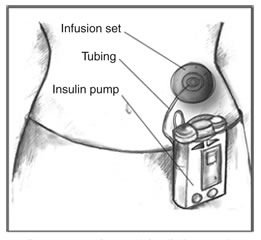
It holds a little black box about the size of a pager. From the box protrudes a small, thin, glistening tube a bit less than half an inch long.

As my brain struggles to make sense of this turn of events – did somebody slip this box down into his shirt when he wasn’t watching? –   Guy suddenly, like a barfly playing dice, smacks the little box down onto the table between us. I gaze at it stupidly, my mouth hanging open and my eyes crossed. I have no idea whatsoever what I am looking at.

“Insulin pump!”,  he declares in a proud tone, gesturing toward the box. “Inventor ought get the Nobel prize for this thing!”

“Insulin pump?”, I repeat.

“It’s a marvel”, he enthuses, “the best thing that ever happened in the last….ohhh…two decades of diabetes management.   I just got it.”

I wonder whether he just got the device or the disease, but I don’t ask.  I’m still processing  the fact that that this little box that was reportedly plugged into his stomach now sits on the tablecloth perilously close to my water glass. Airborne germs,  I remember, are the most contagious kind.

Gazing fondly at the insulin pump, he explains that the tube-like thing is not really a tube. “Think of it more like a catheter”, he suggests, though why he assumes I will think of it at all is anyone’s guess. “It holds a tiny needle in place in my stomach”.

There is only one answer to such a revelation, and I give it. “Oh”.

“This baby right here basically does the job of my pancreas,”  he explains earnestly.  “It’s really revolutionized  diabetes treatment!”

“Hmmm”.

“The amazing thing is”,  he exclaims, leaning in toward me and tapping two fingers affectionately on top of the little box, “it not only does all the work of a pancreas,  you know  – delivers insulin at a steady rate, all day long, twenty four-seven, but I can program it on my laptop,  and I can also  get the carbohydrate count for every single piece of food I put in my mouth!” Tap, tap, tap. He sits back, beaming. ” “Before I put it in my  mouth”.  But there’s one more thing”, he says, holding up a finger.  Expectantly, he waits.  Am I supposed to guess what it is? Does it play music, or light up or something?

I choose the safer route. “Umm…..what?”

He leans forward again and gushes, “It’s got a remote!”

We are interrupted by the arrival of our entrees – my salad, his chicken. The food seems fine until I sneak a close look at the chicken. Bones and skin intact, and seasoned with yellow herbs, it bears an unmistakable resemblance to the moist-looking catheter sticking out of the insulin pump, which still squats mutely on the table between us. Probably, I think, as I fight the nausea, the tube is still warm, having only minutes earlier been yanked from its mooring inside this man’s flesh, inside his stomach.

Why, oh why are we producing our Insulin Pump 25 minutes into a first date? I do appreciate a potential suitor’s timely disclosure of a chronic illness…but is that not what long, confessional night time car rides are for? And emails and letters, and telephone conversations? By this sleight-of-hand production of specialized medical equipment did Guy hope to impress me?  Did he have other magic tricks? Would he suddenly produce a thermometer from his baked potato or a blood pressure cuff from his shoe?

What did this event say about our potential as a couple? The “event”, of course, was not the existence of an illness, no. It was the his choice to produce a personal medical device at this unusual time and place,  in this extraordinary manner. I like surprises as much as the next girl, but balloons and chocolate are more my speed. A definite check mark on the “incompatible” column of my dating flow chart.

As I grazed on my salad, I pondered what Insulin Pump Guy was trying to achieve.  Was this his way of signaling he was seeking a woman who would nurse him, who would become involved  – over-involved, more likely – in the care and  maintenance of his disease? Cause if he was, he needed to keep looking. I’m sympathetic, empathetic, caring, compassionate, generous, and not squeamish.  I  took care of both my parents in the last year of their lives, and considered it an honor and a privilege.

But I’m not looking for a man to caretake. I’m looking for a partner.  And though I am a sucker for scrubs,  I’m not into any  fantasy-doctor-nurse-patient sex scenes, not even if I get the doctor role.  I’m just a regular chick looking for a regular boyfriend. If I wanted to provide medical care, I’d go to medical school, not to OK Cupid dot com.

As the waiter refreshes our water,  my imagination takes flight, as it always does when I am anxious or stressed.  I see myself accompanying Guy to his doctor,  to whom I am expected to provide records of Guy’s blood sugar numbers, or whatever they’re called, levels, I suppose; but I know my scatter-brained self won’t have the numbers organized properly and I’ll give out the wrong ones and Guy will suffer!

And – horrors – I imagine I might have to…cook! Don’t diabetics have to cook carefully? I know they must exert rigorous control over  their diet, but that’s all I know.  I put down my fork; I can’t eat one more a bite of my salad. And now I envision myself again,  this time with what looks like my TV remote in my hand, clicking various combinations of numbers as Guy reads them off his pump, which appears in my imagination to be attached to his stomach by a long, thick yellow tube.  Gross. I am making myself sick!

I don’t particularly enjoy cooking, and I have no idea how to cook special meals. I can cook a chicken, pasta, rice, salad, brownies, a hamburger, and cereal. I don’t know how to cook meals designed for ill people. I can’t make food involving complicated calculations for which I do not have the necessary tools  (measuring cups); I don’t know anything about the esoteric ingredients I suspect might be required (Splenda); and I know none of the  tricks of precision timing and perfect portioning I suspect are necessary for this specialized cooking. It’s all much too far afield for my freewheeling, improvisational, shake- of-this-pinch-of-that cooking style.

Not,  of course, that anyone has asked me to cook for them.

This event tanked any hope I may have had for Guy and me.  I just didn’t want to see him again after our evening at Q—-.   And lest you think me shallow – you’re right. I know how shallow this sounds, deciding not to date a perfectly nice man again just because he yanked a pump out of his stomach at the dinner table on our first date. I admit it. And I know that inside every shallow person a coward is hiding, and I’ll own that too. I probably am afraid of what my future might hold if I hitched my wagon to Guy’s star. Or to the star of anyone offering a chronic, serious illness.

Nevertheless, there is a lesson here, one that transcends these character flaws of mine. (Jot this down, do): “Keep your shirt buttoned”,  I hope you’ll agree, is  a sound rule to live by, at least on the first date, and possibly, also on the second.

Wednesday I Saw My Dead Brother at Safeway

” I’m not overtired, overwrought, overwhelmed, overdramatizing, or overreacting. . . . “
Yes, it’s true.
Last Wednesday Greg and I went to Safeway for shoelaces, and we got separated in the store.

 After searching for him unsuccessfully for a few minutes,  I jogged down Aisle 1 to the back of the store, to walk perpendicular to the aisles so I could look down each one until I found shoelaces and/or Greg.

And that’s how I spotted you.  There in Aisle 7, “Ethnic Foods”,  there you were, yes, you were there: I saw you. You, my brother.  You were wearing those baggy black jeans with the frayed cuffs, your Vans sneakers and a grey hoodie I didn’t recognize. You were alone. You were standing next to the Chinese food shelf, and you were peering at a row of  bottles–oils or sauces, I think. Your hand rested on the cart next to you. I wish now I’d thought to look in it.  I watched in disbelief as you studied the bottles. Then you looked up and that’s when our eyes met.

You  looked just the same as always:  a detached, slightly distracted expression around your eyes,  and some private internal amusement leaving a faint smile on your lips. Not alarming, not scary, except it was alarming and scary, because… you are dead.


Remember? You died in August, 2012.   I know because I was there:  I saw you right before you died.  I know because I was one of the people carrying your coffin over the grassy moguls in the cemetery, transporting you – and I’m sure you’ll understand that we all simply assumed it was in fact you in that coffin, though come to think of it,  the proof was entirely circumstantial, as I never actually observed you inside it – from  from the slope where the rabbi performed the service up and across the wet hilly grass to your grave.  There,  our youngest brother and I and some others,  slipping on the muddy earth, lowered your coffin onto some kind of platform already rigged and waiting to lower you into your grave. Yes. Sobbing, we put you in the ground. Yes. Sobbing, we threw stones onto your coffin. Yes. Sobbing, we heard the rabbi singing. Do you remember, it was raining?

Mostly, I know you died,  because after August 9, I never  saw you again — until last Wednesday, almost two years later.

 Our encounter at Safeway happened fast, much faster than it takes me to recall it,  yet I’ll never forget it.  You looked up from the bottles and jars you were studying, and when our eyes met, I knew at once it was you.  No matter what Greg and my friends say, there was no confusion, no double-take, no having to think about it, and no doubt.  I’m not in denial, drugged, or hallucinating.  I’m not overtired, overwrought, overwhelmed, overdramatizing, or overreacting. I’m not mad, mentally ill, or mistaken. It was YOU. When you glanced up and saw me, your eyes locked right onto mine, but not aggressively, like they did the day before you died, when you could no longer speak with your mouth, and your eyes communicated with that strange, rapt urgency….. Frankly, your gaze was curiously unexcited; gentle,  mildly curious, politely expectant.  As always, a bit amused.


But I was not. Amused, that is. The instant I recognized you, all my fingers simultaneously opened — I mean they straightened — hard, as though to fling off burning embers. I know I took a step back. As I stared at you a shiver started at the back of my neck, and spread slowly up my head, leaving a chilled mix of hot and cold sweat behind my ears and at my hairline. I felt my chest constrict (or maybe that was my heartbeat) , and for a second, I held my breath.  Our eye contact continued a few more seconds until you looked away, back to the shelf you’d been examining. It didn’t occur to me at the time, but now I wonder, were you possibly — hungry?

 I?  Well, yes, I was shocked, of course, yes, shocked to tears. Running into my dead brother in the ethnic foods aisle at the grocery store was not covered in any of the death-and-grieving books I read after you died.  It was not one of “the stages”, you know what I mean?None of my friends who’d recounted their own experiences with the death of a close sibling ever mentioned encountering the dead person in a grocery store.
And the fact is that after two years, I’d finally, reluctantly begun to accept the unbelievable reality that my younger brother – best friend of my childhood, conspirator, confederate,  trustee, confidant, and person who’d known me longer than anyone – you – died, actually died. So you can imagine my surprise at encountering you at all, anywhere…..but at Safeway? The most prosaic place in the world. And you, the least prosaic person.
It’s been almost two years since you left us, and though I am “better” (that is, I  don’t cry as much as I did),  I still cry for you.  Sometimes I feel as though I am the only one who still cries for you.  Your little boys, of course,  have their own way of managing your loss, children grieve differently, don’t they? The twins at six and the oldest boy at ten years old are still young enough to be intrinsically resilient,  both physically and spiritually.  And their memory operates differently from adult memory. It  seems less freighted with emotion and more fact-focused than  ours.


And to her credit, their mother ensures their lives are full, happy,  cluttered with laughter, books, music, explorations, trips,  and experiments; and full of the rich and astonished discoveries that make happy childhoods. They have wonderful lives, your boys, and you are a big part of it.  Their mother understands their intellectual  and emotional limits, and effortlessly keeps you in the centerpiece of their memories.  They talk about you freely and openly, and photos of you are all over the house:  you with all three boys,  you with each boy individually, and  plenty  of photos of all five of you, and of you and their mother. Your stuff remains on the walls and surfaces throughout the house, though the rooms have been painted. Yes, she does a great job.

 Of course, though… she goes on dates,  Not only that, but she laughs and jokes and travels and plays, with her friends and her dates and your little boys. I guess this is what she wants to do.


Our youngest brother laughs and jokes when he recalls funny memories about you, like how when we were little our house was so cold that you used to get dressed every morning under the piano, in front of the heating vent. You sat on the floor blue-lipped and shivering, backed up to the wall and trying to warm up, only our parents kept the thermostat so low that the vent emitted only the mildest whisper of heat, really more the memory of heat than the real thing.

And of course, your friends remember you. They mention  you In their social networking and alumni notes. Facebook friends send you birthday greetings, which seems strange to me.  Really, though,  your friends have moved on;  they sing and check their watches and listen to music and go to work and have sex and play ping pong and watch TV.


Sometimes they think of you, I guess, if something or someone reminds them that once,  you were with us. And now you are not.  And we cannot say where you are. I wonder if anyone still finds these three facts as disconcerting as I do.   I wonder if they understand that the mystery posed by these three facts would be utterly overwhelming but for humankind’s ability to “keep” you preserved in our memory. Indeed,  is that not memory’s primary purpose? To keep a cherished item alive?

Even memory, though, can hurt. That’s why the people close to you have placed a blanket on your memory, so when they remember you, the pain isn ‘t sharp and hard anymore.  Instead, its soft and pillowy. I think I am the only one left who has not muffled your memory.  I know everyone is waiting for me to unfold my own blanket, but if I  too, stuff a blanket onto the shards that were stabbed into my heart when you died,  who will keep you alive – unmuffled and real –  in memory? Who will stay sad for you?


The one false note, the one thing bothering me –  is the market. I’m sure you stopped at Safeway now and again, for…maybe dog food or….shoe laces?  But you were a Farmers Market/Whole Foods/Coop/Trader Joe’s man, weren’t you, so healthy; no transfats, no GMO’s,  all foods organic, local, free range, hormone-free,  all that stuff…you never even ate Chinese food. Whatever were you doing at Safeway?   And by any chance, do you know where the shoelaces are? I never found them.

The Drummer Remembers her Brother


Its been a year since my  brother died, and I ‘m having a hard time letting him go.

Only since his death do I begin to discern the complex singularity of the bond between siblings. Now, when I revisit the corridors of my childhood, I find both my brothers there, with me at every turn, behind every door, in every room –  my confederates in all respects.  I am astonished that in my past journeys here, I did not discern the the constancy  of their presence next to me, and shocked it  took the death of one to illuminate their figures in these precincts we shared.

I study the three of us as we play and fight,  bartering the secrets and promises that are the currency of our childhood.  None of us is aware that every moment we spend together as small children fortifies the bonds that have joined us since  birth.  We do not know that although the adults we’ll become will love and offer intimacies to many, none will know us as long, or as genuinely, as as we  know one another

It isn’t how many years siblings spend together so much as how old they  are – or how young – when they share these years. In  their very early years especially, before children learn guile and artifice, their spirits are authentic and pure, their minds open and without judgment. Together, they travel the frontiers of their world, ingenuous, curious, and eager, confronting the unaccountable perplexities of an adult world that seems forever unknowable.

As I watch us play, trying on the roles and establishing  the hierarchies that will follow us into adulthood, I am struck by how we three very young explorers share our discoveries–triumphantly,  and with real joy. This more than any act cements our bond, for nothing brings persons closer than discovering new lands together. And small children and their brothers and sisters discover new lands together over and over again throughout their childhood.

Eventually, though, their ardor dims, and it continues to diminish as they grow into us: bored, blase, jaded, indifferent adults.  My  brother never really lost his zeal for discovery. I don’t think his sense of wonder ever dimmed. Now, I see it in the faces of his three small sons, but even as the sight assuages my grief, it makes me miss him even more.

(2013) IMG_0040

My brother Milton: Nov. 1959 – Aug. 2012.


The Drummer Sees Two Moons

Ok yah so I’ve seeing two moons, like – every night when there is a moon, for, maybe, almost three months – yah, moons, you know, moons in the sky? So I’m wondering how come no one’s talking about this, I mean, it must be a pretty big deal, right, like a paradigm shift, you might say, right?  Earth now has two moons, you’d think there’d at least be a newspaper article…..but nothing.

Most nights, I go out; see, I’m on a mission to get the lowdown on this new moon. I’m looking for crowds, stargazers, maybe college professors with students, gesturing at the sky….but I am the only one who studies it. I can’t take my eyes off the two moons, that’s the truth, I watch them rise together, so close to one another it’s as though they were attached. I don’t know what to make of the fact I have not heard nor read even one report about Earth now having two moons. I don’t run with astronomers or anything, but I mean, wouldn’t it impact us?  Here on Earth?  Two moons, I mean, wouldn’t that affect, I don’t know, the tides or something?  Or the sun….I don’t know, I’m no astrophysicist, but it just seems like kind of an important development, right?

After about two weeks, I begin to worry I might be hallucinating, or even mentally ill.  Which would be a big drawback in every respect. I don’t want to tell anyone about the second moon because I am not sure it’s real, since I seem to be the only person seeing it. I could have developed a mental illness suddenly, couldn’t I?  I might have, like…say, Multiple Personality Disorder, or something, like that woman Sybil in that movie? And maybe it’s one of my personalities who is seeing the second moon?  But why would one of my personalities see two moons?  I don’t even know–could I maybe ask it?  The personality! Can you converse with your own personalities if you have Multiple Personality Disorder? Cause if you could, I’d ask it why it sees a second moon, right? Good plan!

I don’t want to come right out and talk about this second moon, just in case I have gone nuts. So when I’m out at night with friends, I start nonchalantly sort of introducing the topic, like, “so how ’bout that crazy night sky?”,  with a casual jerk of my head in the general direction of the moon(s).  Or I exclaim, “check out those planets!”, but no one takes the bait.
I grow more anxious as days pass with not even a Facebook post about it.  I research Multiple Personality Disorder, and when none of the symptoms applies to me, I’m actually kind of bummed out, that’s how stressed out I am about this business with the moons. To double check, in my bedroom, I stand still, and then suddenly twirl around dramatically to face the mirror, figuring I can maybe catch one of my multiple personalities off guard…but it just makes me dizzy. Almost fearfully,  I check the night sky. The two moons are as close together as they were before, one might even be overlapping the other a bit.  I remember that some diseases cause you to get raving mad?  Like, could I have …syphilis? Or — rabies? But don’t I need a bat bite or something to get rabies?
Then I consider the alternative to mental illness (aside from the chance there really are two moons):  hallucinations. It’s possible, I realize, that I am not insane; instead, for some reason, I’m hallucinating two moons.  This would be an extremely specific type of hallucination, a lunar hallucination, actually, a double-lunar hallucination, and I’m damned if I can think of a reason I might develop double vision for just one particular planet, and nothing else….I check it out, and confirm I don’t see two of anything else (unless there are two of something else, obviously; for instance, I see two twins, not four, that’s what I am trying to say. If I knew twins, I mean, I’d see two, not four, but I don’t know any twins, but I check it out thoroughly, and only the moon has doubled, nothing else).
So finally, I go to the eye doctor, where I haven’t been since I was about eight years old. The same doctor sets my chin on the same machine and shows me the same black letters lined up on the screen, asking me to compare: is this one better or worse, better or worse, better or worse?  I’m like, proud, you know, when I pass that test, like, with flying colors, I’m pretty sure (but you’d think in these last 30 years they would have invented something a little more high-tech than the better-or-worse test, right?).
Then, I confide in him the mystery of the two moons. He listens carefully, and he nods a couple of times almost as though he’s heard this before.  Then, to my overwhelming relief,  he clears it all up. I am not crazy. I am not hallucinating, not really. I probably don’t have Multiple Personality Disorder (although remember, of course, the doc is an optometrist, not a psychiatrist, they’re pretty different specialties, obviously).
Anyway.  The best news is that there is still just the one moon. What I have is a cataract, a cataract in one eye, and something about it and my lens and the night light and the reflection or the refraction or the reaction or something — causes my eyes to see two moons.  I even have a smaller cataract in my other eye!  This is great news!  I want to kiss this doctor (but I don’t). I am not crazy! I am actually happy to learn that I share a medical condition with people so old, they are even older than my own grandparents would be if they were alive; the oldest division, or chapter, or whatever, of our population.  I don’t mind, so what if the surgeon’s waiting room will be filled with double-planet-seeing blue-hairs reading AARP Magazine!  (Which is pretty much exactly what I see a week later when I visit the surgeon for the first time.)
Even the news that to cure this will require the introduction of a laser beam into my eyeball,  which seems kind of, you know, counter intuitive, can’t diminish the relief I feel at learning I am sick, not crazy.  ‘I have a delicate medical condition’, I tell myself. Even the expense of the proposed surgery doesn’t dim my euphoria – my world hasn’t changed, and I can reside there a little longer;  my world, where I belong,  where I don’t hallucinate, where there is just one moon in the sky, and where the people around me are (allegedly) sane (even if some could have Multiple Personality Disorder. You wouldn’t necessarily know if you met a person with it, would you? Not until you’d met them again and again, and each time, a different personality greeted you, then you’d guess something was up…).
Then I start to worry about my other eye, which also harbors a cataract.  What tricks will it play on me?  How will I know?  Will it give me a fake double vision? Or will it be much craftier than that? Like– I start seeing piles of money lying around, and jumping on them? Will it make objects triple…or maybe disappear?   Or will it make me see, I don’t know, like a herd, or whatever — a flock, I guess  —  of ostriches crossing the street?  Or, like…wings on cars?  Or maybe…red-hot lava and quicksand churning along the street where I live….
I’ll report on that insanity when it begins. For now, you can rest easy knowing the Drummer’s happy temperament has been restored by the diagnosis of an expensive, dangerous eye disease.  That’s irony, right? Or is it paradox? Anyway, it’s pretty crazy, right?